
Three Harper County Release Dates
A projected release date, or PRD, is ODOC’s estimate of when a person will leave prison. A parole eligibility date marks when a person may be considered for parole. An actual release or discharge date records what happened. None of these labels should be substituted for another. Eligibility is not a promise, and an estimate is not proof that the person left custody.
A Harper County Jail bond or time-served discharge is also outside the public ODOC PRD computation unless the person is serving an ODOC sentence. The jail’s record shows when Harper custody ended and where the person went. A court order supplies legal authority, but processing, identity checks, property, paperwork, and another valid hold can separate the order time from the physical release time.
| Date | Meaning | What it cannot prove |
|---|---|---|
| Projected release date | ODOC estimate based on current sentence and credit data | Exact future release or freedom from another hold |
| Parole eligibility date | Point when a case may qualify for consideration | Grant, Governor action, or physical release |
| Actual discharge date | Recorded event showing a named custodian ended control | That every other custodian or supervision term ended |
| Court release order | Legal authority directing a custody outcome | The jail’s physical door time |
Run a Harper Release Date Lookup
Start with the place and sentence type. A person who only bonded out of Harper County Jail may never appear in ODOC. A Harper defendant committed to state prison should be followed through the DOC number. Federal and immigration custody require their own locators and should not be mixed into a county or state date.
- Determine whether the person is in Harper County Jail, ODOC custody, another county, federal custody, or immigration custody.
- For ODOC, open the Oklahoma offender search. Use the DOC number when known, or exact first and last name with date of birth.
- Compare the matching record’s identity, sentence, sentencing county, case or CRF number, status, and facility or office. Transcribe any date exactly as labeled.
- Search the Harper criminal case through OSCN and the live county selector at ODCR. Check the judgment, jail-time credit, amended orders, revocation, appeal, or completion entry.
- For a county-only sentence or pretrial stay, call Harper County Jail at 580-735-2213 and ask for the commitment and discharge record. The court explains legal authority; the jail confirms physical release.
- If the ODOC public view lacks a reliable actual event, submit the official open-record request for existing custody, last-movement, release, and supervision records.
The official ODOC search form is shown below. It accepts an OK DOC number, first name, last name, and date of birth, with options for aliases and similar-sounding names.
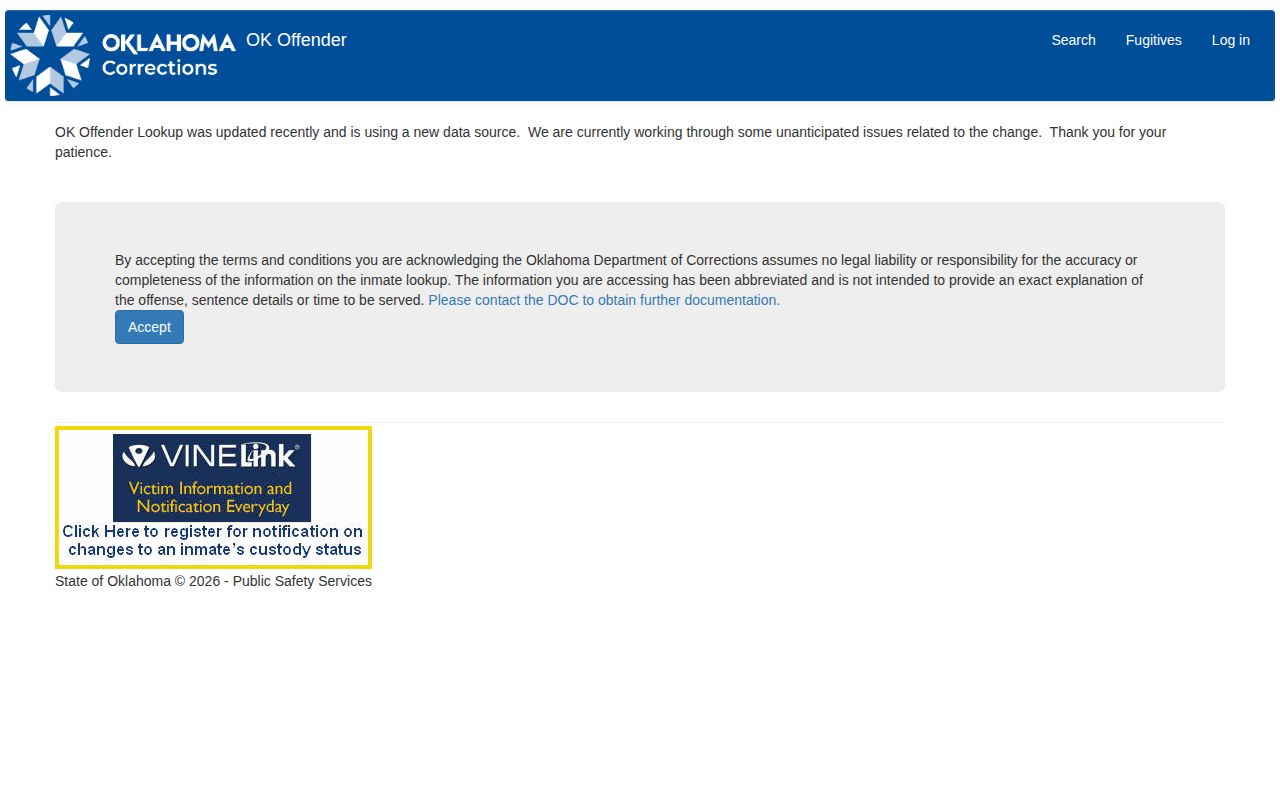
The display may include state corrections details, but “inactive” is not a release type. A projected field may be absent, and no date shown there should be rewritten as an actual discharge without a source event.
Federal dates follow different rules. The Bureau of Prisons locator may show a future projected date or a past release date. A past date with no facility location, or a “Released” result, means BOP custody ended. It does not prove the end of federal supervision, immigration custody, or a state hold. A U.S. Marshals pretrial case and an ICE detention matter require their own court or agency routes.
Harper Projected Date Limits
Oklahoma’s public guidance creates a real tension. The Pardon and Parole Board glossary defines PRD as the date ODOC calculates to estimate prison release, and an ODOC public-information policy references projected-date information. Yet the current ODOC FAQ says a precise inmate release date is confidential without a qualifying need, tells the inmate the monthly days remaining, and warns that any date is tentative.
The safe reading is narrow. A projected date may appear on a public record or source document, but ODOC does not promise a precise public date for each person. When shown, it remains an estimate. When absent, do not guess from sentence length or ask staff to create a future calculation that the agency treats as confidential.
The official ODOC offender information page captures those confidentiality and tentative-date limits.
Use the displayed estimate only for orientation. An authorized inmate or records route may clarify the underlying sentence computation. After release, request the actual discharge entry rather than trying to preserve an old estimate as if it were final.
Note: A pretrial Harper County detainee has no ODOC projected release date; bond, court action, and holds control the timing.
Oklahoma Credits for Harper Sentences
Oklahoma uses earned credits rather than a flat universal percentage for each state sentence. Under 57 O.S. §138 and ODOC’s sentence-credit guide, classification changes the days remaining. The described levels award zero, twenty-two, thirty-three, or forty-four monthly credits. Enhanced eligible levels may award forty-five or sixty. These are state sentence-administration rules, not a Harper County jail promise.
| ODOC level | Monthly earned credits described | General basis |
|---|---|---|
| Level 1 | 0 | Lowest credit class |
| Level 2 | 22 | Classification based on current performance |
| Level 3 | 33 | Higher qualifying performance level |
| Level 4 | 44 | Highest standard level described |
| Enhanced eligible levels | 45 or 60 | Only when eligibility and program rules support them |
Classification can reflect work attendance and productivity, conduct, program participation, cooperation, and living-area or appearance standards. Misconduct or nonperformance can remove credits. Section 138(C) permits discretionary restoration in qualifying circumstances. Achievement credits, court-ordered jail credit, and sentence structure can also change the calculation.
ODOC’s guide describes post-sentence county time while a person awaits state reception. It applies Level 2 deferred-reception treatment and a .73 earned-credit multiplier along with jail-time deductions. That rule administers an ODOC sentence. It does not establish a Harper county-only “good time” formula.
- Earned credit
- A sentence credit tied to the governing statute, classification, conduct, or achievement.
- Jail-time credit
- Time the court or ODOC recognizes from qualifying custody before state reception.
- Days remaining
- ODOC’s changing sentence balance, supplied monthly to the inmate under current guidance.
- Restoration
- Discretionary return of qualifying lost credits under the applicable rule.
Harper Release and 85 Percent
Oklahoma’s “85% law,” 21 O.S. §13.1, lists serious offenses. Public parole guidance says listed or violent categories generally require service of eighty-five percent before parole consideration. The conviction date and statutory class matter. The law should not be treated as a simple formula for the exact day a person will walk out.
Historical nonviolent parole eligibility can involve one-quarter or one-third rules, depending on the law and sentence history. Death and life-without-parole sentences are ineligible. Administrative parole has added exclusions, including listed violent and Section 13.1 offenses. A universal “one-third” rule would therefore be wrong.
Eligibility remains separate from a projected release date. It is also separate from an actual parole result. A favorable Board action may depend on the type of case, Governor action, stipulations, processing, or unresolved holds. The sentence record and current agency result must control.
Parole eligibility can change after a file audit, corrected jail credit, postconviction relief, appeal, commutation, misconduct close to a hearing, or a waiver. The Board outcome can also be a pass or denial rather than a grant. These events affect the route toward possible release, but none should be silently inserted into a public projected-date field.
Why Harper Release Dates Move
ODOC’s projected date is dynamic. It can move when credits are earned, removed, restored, or corrected. It can also change when the underlying sentence record changes. This is the distinctive Oklahoma feature behind a Harper release date lookup: monthly credit levels do not translate into one fixed public percentage.
| Factor | Possible effect | Best explanation source |
|---|---|---|
| Earned-credit level | Changes the rate at which days remaining fall | ODOC classification and credit record |
| Misconduct or nonperformance | Can remove credits and move the estimate later | ODOC disciplinary and credit record |
| Achievement credit | Can reduce days when statutory and program rules apply | ODOC sentence calculation |
| Jail-time correction | Can revise the recognized starting balance | Court order and ODOC audit |
| Sentence audit | Can correct terms, concurrency, or prior data | ODOC Sentence Administration |
| Court change | Appeal, postconviction relief, or amended judgment can alter the term | Harper court docket and filed order |
| Parole action | May create a conditional path out of prison but can require further action | PPB result and ODOC release event |
| Another hold | Can prevent return to the community after one custody ends | Releasing and receiving custodians |
No Harper County jail good-time rule, fixed weekend-release practice, or standard release hour was verified. For a county-only sentence, ask the court how jail credit was ordered and ask the jail how the commitment was applied. Do not import ODOC’s state-prison rules into the county facility.
Confirm a Harper Release Date
The strongest verification hierarchy starts with a displayed estimate for orientation, then uses the sentence and credit record to explain it. A custody alert can flag a reported change. The actual discharge record confirms the event. This sequence avoids treating a future field as proof that release occurred.
For ODOC records, identify the full name, date of birth, DOC number, Harper County case or CRF number, and date range. Request the existing public record showing actual release or discharge date and type, last movement, and supervision status. The ODOC open-records form is the formal online route. Closed Records can be reached at 405-425-2691, while discharge matters are listed through osordischarges@doc.ok.gov.
For Harper County Jail, call the Sheriff at 580-735-2213. Ask for the booking and physical-discharge timestamps, release manner, authority, and destination. A transfer out of Harper custody is not community release. If a court order is involved, compare it with the Sheriff’s execution record.
Harper County has no verified county-jail release-date calculator, current roster, fixed release hour, weekend rule, or online archive. The Open Records Act provides access to existing nonexempt records but does not require a custom forecast. A narrow request for a named person’s existing commitment and discharge entries is more accurate than asking the Sheriff to predict a future release day.
Registering through the Harper County VINE inmate check can add a pending custody-change alert. VINE may lag and does not preserve the final record. After the alert, contact the reporting custodian and obtain the actual event.