
Harper County VINE Coverage
Oklahoma calls the service OK VINE. It provides free, confidential custody information and notifications based on data sent by participating Oklahoma agencies. A person may check one individual anonymously by toll-free phone, the VINELink website, or the app. The service follows reported custody events from arrest through sentencing and release.
For a Harper County inmate check, the reporting agency is crucial. A record tied to Harper County Jail concerns the Sheriff’s custody. An ODOC record concerns Oklahoma state corrections. The same person may move between those systems. VINE does not turn those separate events into one full release history, and no verified Harper County online release list exists to fill that role.
The official Oklahoma VINE coverage page is shown below. It confirms the state service and gives users a government source before they enter a name on VINELink.
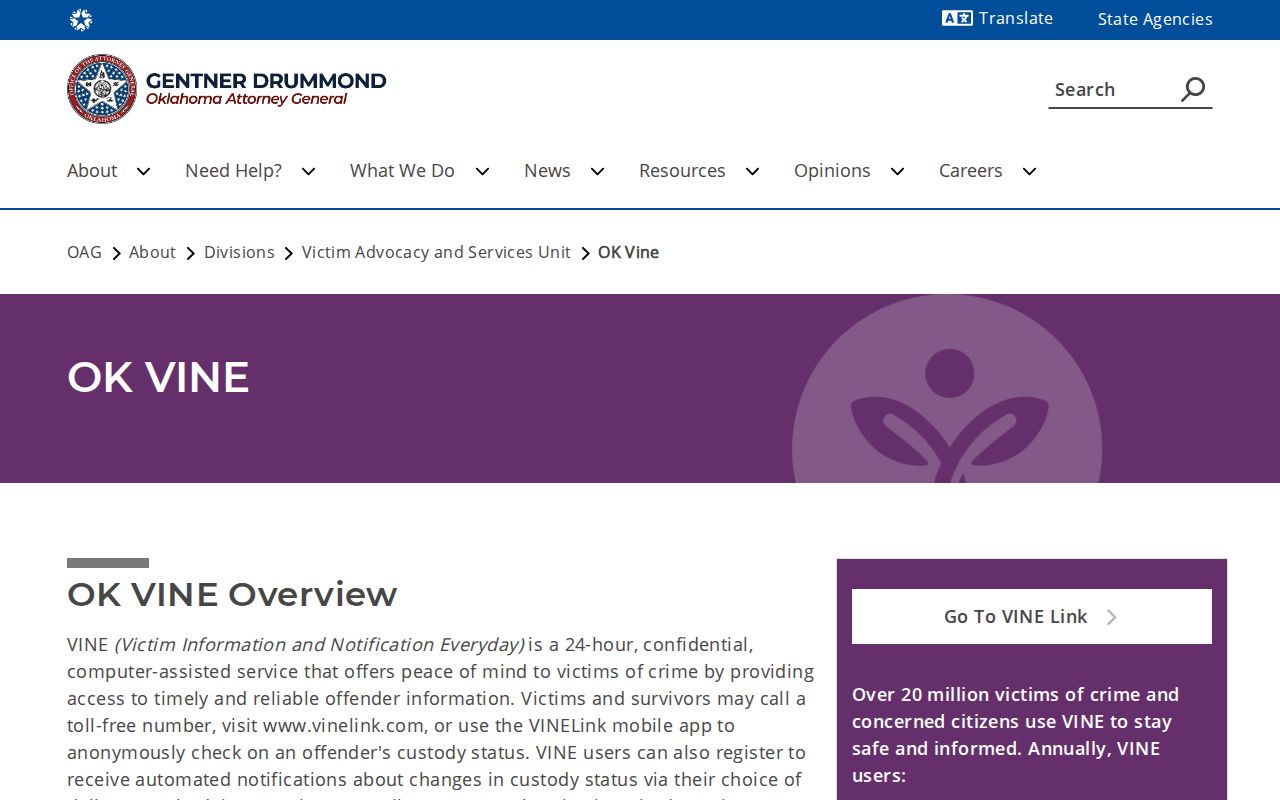
The statewide VINE line is 1-877-654-8463. Language help and a live operator are available. The Attorney General program contact is 405-521-3921, while ODOC Victim Services can assist with state corrections movement and release questions at 405-425-2607.
Search One Harper County Inmate
A VINE inmate check is built for one specific person. It is not a list of everyone released during a day or weekend. Gather the exact name, date of birth or age when known, and an agency or offender ID if available. Those details reduce the risk of selecting someone with a similar name.
- Open VINELink and select Oklahoma.
- Choose the offender or custody search. Enter the exact name, or use the agency or offender ID when the interface offers that field.
- Review every possible match. Compare age or date of birth, the reporting agency, and any other identifier shown.
- Open the correct individual record. Read the exact custody status, agency, location or event, and date as labeled.
- If the record says release, confirm whether that custodian recorded community release or a handoff to another agency.
The captured VINELink screen below shows the Oklahoma search environment documented for this project. Live labels can change, so follow the current prompts rather than an old set of screen directions.
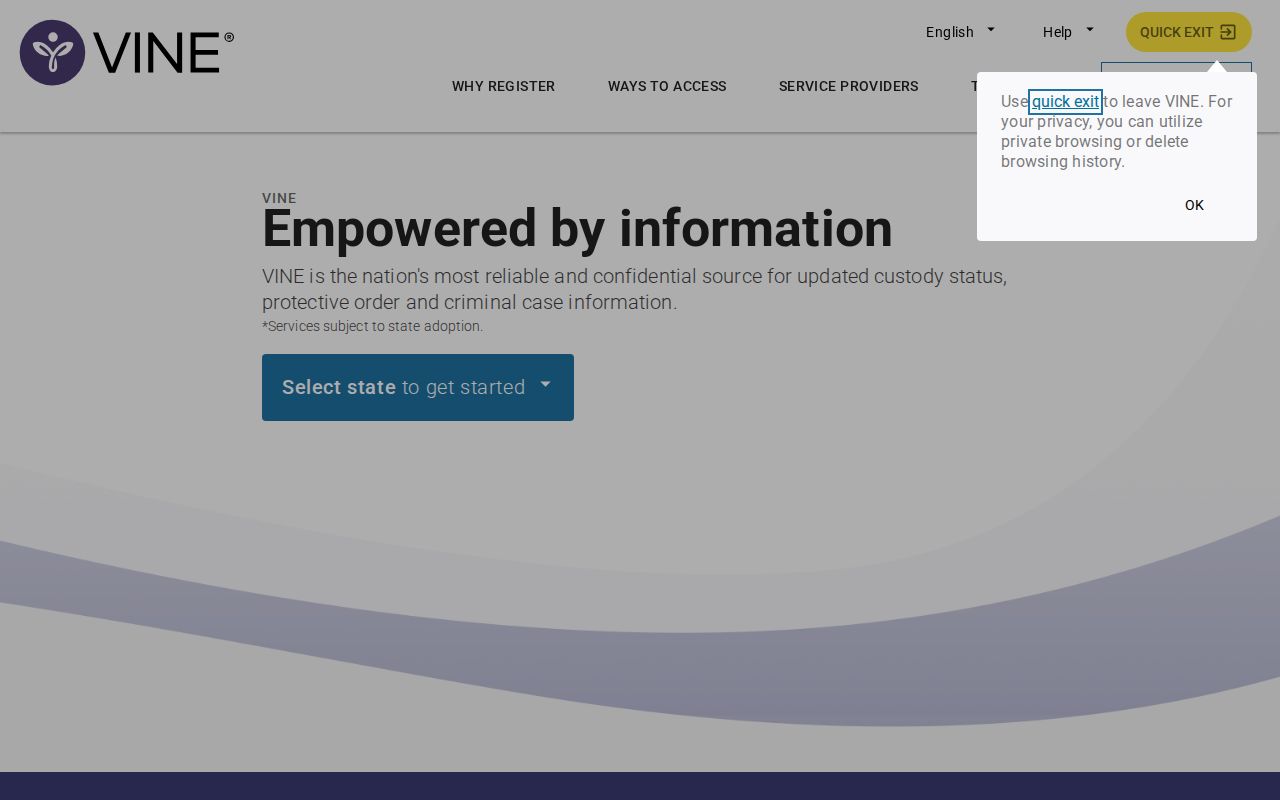
A no-result is not proof of release. Spelling, a new booking, delayed agency data, a transfer, or a record under a different custodian can affect the search. For a Harper jail case, call the Sheriff at 580-735-2213 and request the actual discharge entry when the answer must be durable.
Read Harper County VINE Results
The useful fields identify the person, the agency sending the data, and the kind of custody event. Read them together. A date without an event label can be misunderstood, while a status without the source agency cannot tell which custody ended.
| Displayed item | How to read it |
|---|---|
| Name and identifier | Use with age or date of birth to distinguish similar matches. |
| Reporting agency | Names the custodian whose data produced the result. |
| Custody status | Shows the current state reported to VINE, subject to delay. |
| Event type | May state transfer, escape, apprehension, release, or death. Do not merge the labels. |
| Event date | Dates that reported event, not an all-agency release history. |
| Location | May help identify a facility or office, but absence does not prove community release. |
| Notification choices | Shows which telephone, text, email, app, or TTY channels are then available. |
An image may appear if the reporting agency supplies one, but VINE does not promise a photo and is not a booking-photo archive. Likewise, a projected prison date is not the same as an actual VINE release event. When a date affects plans, compare it with the original jail or ODOC record.
Expected event types include escape, apprehension, transfer, release, and death. Each label carries a different fact. An apprehension notice reports renewed custody after an escape or similar event. A transfer notice reports a move. Neither can be shortened to “released.” A death notice must also be treated as its own event, not as an ordinary discharge.
Set Harper County Release Alerts
Notification registration begins only after the correct person record has been opened. Do not register from an uncertain match. The available methods can include telephone, text, email, in-app notice, and TTY. Each method requires a current destination and some form of verification.
- Select registration or notifications from the matched record.
- Choose an offered contact method and enter the phone number, address, or app destination.
- Complete the verification prompt. Preserve any confirmation message.
- For telephone alerts, create the requested PIN. This PIN is for notice receipt, not the inmate’s ID.
- When the automated call arrives, enter the PIN to confirm receipt and stop repeat calls.
- Save the reporting agency’s contact information so a transfer or release alert can be checked at its source.
Keep the PIN private. If a phone number or email changes, update the registration through the current VINELink process. Alerts can be missed when a number is blocked, an inbox filters the message, or the source agency has not yet sent the event.
Registration is free, and anonymous status checks do not require the searcher to establish a personal account merely to view a record. Notification setup does require a working destination so the chosen method can be confirmed. The live service controls which methods appear for a given record. Do not promise that all five channels will be offered in every case.
- Custody alert
- A notice that the reporting agency recorded a listed event.
- Transfer
- A move from one custodian or facility to another, not necessarily a return to the community.
- Release
- The end of the reporting custodian’s control as coded in its VINE data.
- Discharge record
- The source agency’s lasting record of when and how custody ended.
Harper VINE and Parole Notice
Oklahoma has two different notification layers. OK VINE provides custody alerts. The Oklahoma Pardon and Parole Board provides a separate written process for parole proceedings. The Board expressly says VINE does not send parole notification. A person who needs Board notice must use the PPB victim-notification process instead of assuming a release alert covers a hearing.
The PPB VINE limitations page also identifies an uncommon state-system gap. A transfer from ODOC to a Department of Mental Health facility can deactivate VINE until the person returns to ODOC.
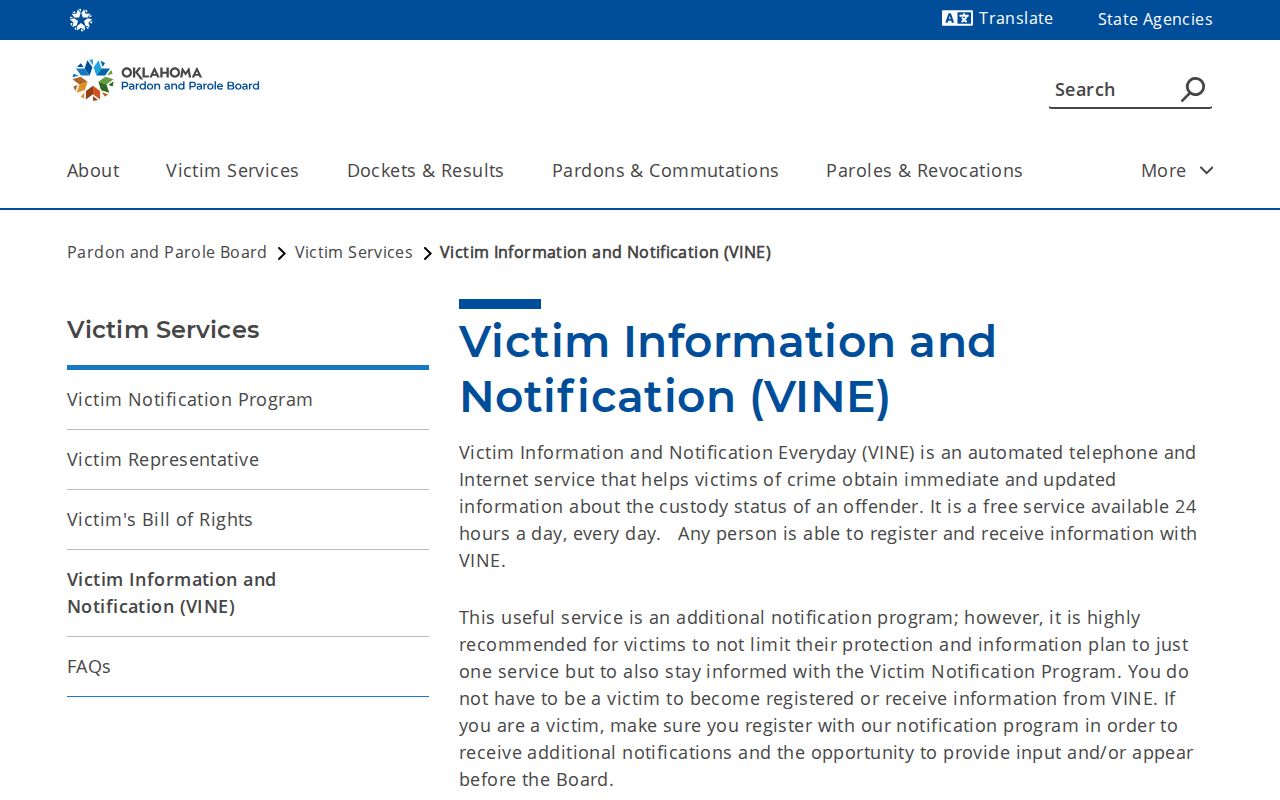
This distinction prevents a custody notice from being read as proof of parole status. Check the PPB docket and result for the hearing, ODOC for state custody or supervision, and the source facility for the physical release event.
The separate Harper County post-release supervision page explains how the Woodward office, the offender search, and Board results fit together. A favorable Board result can still be subject to later action, stipulations, processing, or an unresolved hold.
Harper VINE Versus Registries
Oklahoma’s sex- and violent-offender registries are not VINE and are not general release lists. They cover only people required to register under the governing laws. A registry entry can remain while a person lives in the community. It does not establish a new arrest or current jail custody.
The official ODOC sex-offender registry search may help only when the person is within that limited class. Questions about a registration record can be routed to the ODOC registry unit at 405-425-7601 or osor@doc.ok.gov. Discharge-specific correspondence is separately listed at osordischarges@doc.ok.gov.
Do not use a registry no-result to infer release. For an ordinary Harper County detainee, the Sheriff’s discharge record remains the local source. For an Oklahoma state prisoner, the ODOC release or discharge event is stronger than either a registry entry or an alert.
Confirm Harper County VINE Releases
VINE data can lag. It is not a permanent historical database, a Harper recent-release feed, a court docket, or a federal locator. It also cannot show that every possible hold has cleared. Use the alert as a prompt to contact the agency named in the result.
The federal limits are firm. The Bureau of Prisons maintains its own inmate locator for sentenced federal custody. U.S. Marshals pretrial detention is followed through the federal case and agency records because there is no public USMS person locator comparable to VINE. ICE has a separate detainee locator with a limited post-release window. A Harper name should be routed to one of those systems only when the custody facts support it.
For Harper County Jail, call 580-735-2213. Ask whether the person was physically discharged, the date and manner, and the destination. If a durable record is needed, request the jail-register or booking and discharge entry under Oklahoma’s Open Records Act. Section 24A.8 supports access to the date or manner of discharge or escape if the jail register is kept, but it does not require the Sheriff to create a new report.
For ODOC, use the offender search and request the existing actual release or discharge event, last movement, and supervision status when the public display is unclear. Do not turn “inactive” into a release type. For federal custody, use the BOP locator. ICE and U.S. Marshals matters have their own systems. The main Harper County released inmate search maps those routes by custodian.
ODOC Victim Services lists 405-425-2607 and victim.services@doc.ok.gov for movement and release information and VINE help. That office can explain the notification channel, but the resulting alert still is not a certified release record. For a correction to a state custody entry, use ODOC’s individual record-review procedure rather than trying to change VINE alone.
Record the event wording, date, and reporting agency when an alert arrives. Those details let the Sheriff or ODOC locate the corresponding source entry without treating the alert itself as final proof.
Note: A VINE alert is useful corroboration, but the reporting agency’s discharge record is the stronger long-term proof.